
- NAMLOC
- Mutual Evaluation Report – Tab 1
- Mutual Evaluation Report – Tab 2
- National Risk Assessment (NRA)
- News
- Gallery
- Legislation
- Saint Lucia’s NRA
The NAMLOC Director provides guidance of the NAMLOC Secretariat, ensuring Saint Lucia’s compliance with the FATF 40 Recommendations and 11 Immediate Outcomes. The Director oversees staff, work plans, reporting, budgets, stakeholder engagement and training
The NAMLOC Project Officer supports coordination between the Attorney General’s Chambers, NAMLOC, and stakeholders. The officer monitors NAMLOC’s work programme, assists with quarterly and annual reports, coordinates meetings, workshops, and conferences.
The Secretary provides administrative support to NAMLOC by managing calls and correspondence, coordinating meetings, preparing official documents, maintaining records and databases, and following up on assigned tasks.
Mutual Evaluation (MER) Process – Overview
The Mutual Evaluation Report (MER) process is a structured, peer-review assessment undertaken by the Financial Action Task Force (FATF) and FATF-style regional bodies (such as the Caribbean Financial Action Task Force – CFATF) to evaluate a country’s anti-money laundering, counter-terrorist financing, and counter-proliferation financing (AML/CFT/CPF) framework. The primary objective of the MER process is to ensure that jurisdictions have robust systems in place to combat financial crime and protect the integrity of the international financial system.
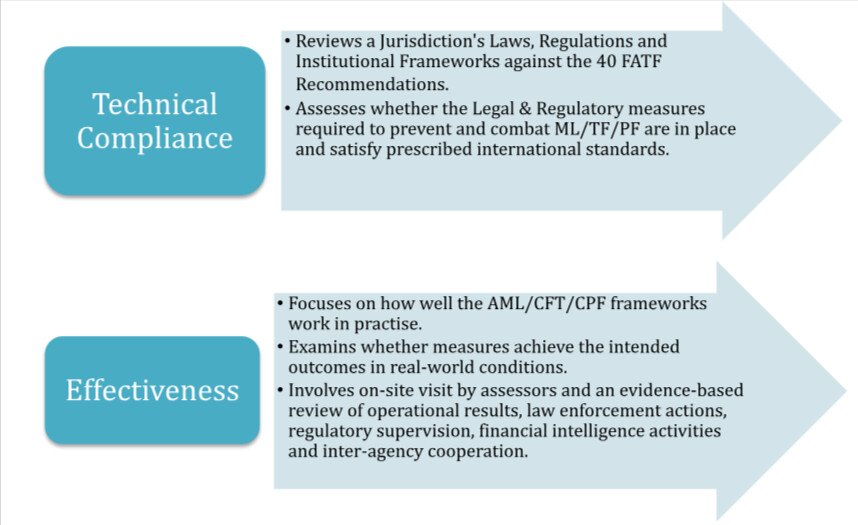
The MER process comprises two core components:
Throughout the process, countries are required to:
- Conduct a National Risk Assessment (NRA) in order to identify and understand their money laundering (ML) terrorist financing (TF) and proliferation financing (PF) risks.
- Demonstrate a risk-based approach (RBA) to AML/CFT/CPF regulation and supervision.
- Provide comprehensive documentation, statistics, and evidence to the evaluation team.
- Engage with the evaluation team during the on-site visit and respond to follow-up questions or requests for documentation/ information.
The MER culminates in a detailed report rating the jurisdiction’s performance on technical compliance and effectiveness. The outcome frames future action plans, enhancements to the legal framework, and targeted interventions to strengthen systems where needed.
While the 4th Mutual Evaluation focused heavily on whether Saint Lucia’s AML/CFT framework met technical standards, the 5th Mutual Evaluation places far greater emphasis on how well those standards are implemented in practice. The assessment will require clear, measurable evidence that FATF Recommendations and the 11 Immediate Outcomes are producing tangible results consistent with the country’s risk profile.
The below table identifies the key differences between 4th vs 5th Round Mutual Evaluation
Evolution of FATF Recommendations: 4th vs 5th Mutual Evaluation Rounds
FATF Recommendation Area | 4th Round – How Recommendations Were Assessed | 5th Round – Changes and Key Focus |
R.1 – Risk-Based Approach | Focus on whether a National Risk Assessment (NRA) was completed and whether AML/CFT measures were broadly aligned with identified risks. | Strong emphasis on dynamic, ongoing risk assessment and demonstrable use of risk findings to guide supervision, enforcement, and policy decisions. |
R.10–12 – Customer Due Diligence (CDD) & PEPs |
| Focus on quality and consistency of CDD implementation, including effectiveness of enhanced measures and supervisors’ ability to identify weaknesses. |
R.13–17 – Correspondent Banking & Reliance on Third Parties | Review of regulatory controls and safeguards to prevent misuse. | Increased scrutiny on de-risking practices, proportionality, and alignment with FATF financial inclusion guidance. |
R.15 – New Technologies & Virtual Assets | Limited focus; early-stage regulatory expectations for emerging risks. | Significantly expanded focus on Virtual Assets (VAs) and Virtual Asset Service Providers (VASPs), including licensing, supervision, and enforcement. |
R.24–25 – Beneficial Ownership | Focused on availability of legal mechanisms to obtain beneficial ownership information. | Strong focus on accuracy, timeliness, and verification of beneficial ownership information and authorities’ ability to access and use it effectively. |
R.26–28 – Supervision of Financial Institutions & DNFBPs | Emphasis on supervisory powers and existence of AML/CFT frameworks. | Focus on risk-based supervision, supervisory outcomes, sanctions, and effectiveness of remedial actions. |
R.29–32 – Financial Intelligence & Law Enforcement | Assessment of institutional mandates and information-sharing mechanisms. | Focus on use of financial intelligence in investigations, integration between FIU, law enforcement, and prosecutors, and results achieved. |
R.35 – Sanctions | Focus on availability of administrative and criminal sanctions. | Evaluation of whether sanctions are effective, proportionate, and dissuasive, supported by enforcement evidence. |
R.38–40 – International Cooperation | Assessment of legal gateways and ability to cooperate. | Stronger focus on timeliness, quality, and outcomes of international cooperation requests. |
Targeted Financial Sanctions (R.6 & R.7) | Focused on legal frameworks and designation processes. | Greater emphasis on implementation effectiveness, monitoring, and private-sector compliance. |
Proliferation Financing (R.1, R.2, R.7) | Treated largely within broader AML/CFT structures. | Standalone, intensified focus reflecting FATF’s enhanced Proliferation Financing (PF) standards and expectations. |
11 Immediate Outcomes – Shift in Focus from 4th to 5th Round Mutual Evaluations
Immediate Outcome (IO) | 4th Round Focus | 5th Round Focus |
IO.1 – Risk & Policy Coordination | Risk identified and policies established. | Risk actively drives decisions and results. |
IO.2 – International Cooperation | Legal ability to cooperate. | Cooperation that is timely and effective. |
IO.3 – Supervision | Supervisory frameworks in place. | Effective, risk-based supervisory outcomes. |
IO.4 – Preventive Measures | Obligations imposed. | Quality of compliance in practice, proportionate and dissuasive. |
IO.5 – Legal Persons | Access to ownership info. | Accurate and verified beneficial ownership. |
IO.6 – Financial Intelligence | FIU functioning. | Intelligence used to generate results. |
IO.7 – ML Investigation & Prosecution | Powers available. | Successful cases and convictions. |
IO.8 – Confiscation | Legal mechanisms exist. | Assets traced, seized, and confiscated. |
IO.9 – TF Risk & Disruption | Legal framework exists. | Terrorist Financing (TF) activities detected and disrupted. |
IO.10 – TF Preventive Measures | Sanctions implemented. | Effective monitoring and enforcement. |
IO.11 – PF Sanctions | Framework in place. | Active, effective Proliferation Financing (PF) sanctions regime. |
| 4th Mutual Evaluation Report (Completed) | 5th Mutual Evaluation Report (Upcoming) 2028 |
Assessment Framework | FATF 40 Recommendations and 11 Immediate Outcomes under the 4th Round methodology. | Revised FATF Standards with stronger emphasis on effectiveness, proportionality, and sustainability under the 5th Round methodology. |
Expected later in the cycle, following completion of Enhanced Follow-Up and national preparatory work. | On-site Visit | Conducted September 16–27, 2019 by a 7-member CFATF assessment team. |
Stakeholder Engagement | Interviews with over 50 public and private sector entities. | Deeper focus on how stakeholders implement reforms in practice, including NPOs, DNFBPs, and Competent Authorities. |
Publication Date | MER published January 2021. | To be published following the 5th Round on-site assessment (date to be determined). |
Overall Findings | Identified significant technical and effectiveness gaps, leading to placement in Enhanced Follow-Up. | Will assess whether reforms since 2021 have translated into demonstrable, sustainable effectiveness. |
NPO / NGO Focus | Weak understanding of NPO TF risk, limited oversight, and gaps under Recommendation 8. | Strong focus on targeted, risk-based oversight of at-risk NPOs, avoidance of over-regulation, and sector engagement. |
Risk-Based Approach | Risk-based framework still developing and uneven across sectors. | Expectation of mature, well-evidenced risk-based decision-making informed by NRA findings. |
Effectiveness Emphasis | Initial implementation stage for many AML/CFT measures. | Heavy emphasis on outcomes, results, and real-world impact (Immediate Outcomes). |
|
|
|
Key Milestones Since the 4th MER
Technical Compliance Progress Snapshot
- 20 of 22 Recommendations applied for were upgraded.
- 15 Recommendations rated Compliant.
- 5 Recommendations rated Largely Compliant.
- 2 Recommendations remained Partially Compliant.
- Overall status: 35 of 40 FATF Recommendations rated Compliant or Largely Compliant.
- With the submission of the 5thEFUR published November 2025, Saint Lucia is no longer in Enhanced Follow-Up.
SUBTITLE: MEMBERS of NAMLOC
The National Anti-Money Laundering Oversight Committee (NAMLOC) established by Cabinet Conclusion to coordinate Saint Lucia’s national response to money laundering, terrorist financing, and proliferation financing. Its membership reflects the country’s commitment to a comprehensive, approach that combines intelligence, regulation, enforcement, and prosecution.
Member Agencies
- Attorney General’s Chambers – Provides overarching legal leadership and policy direction through NAMLOC, ensuring Saint Lucia’s legislative and institutional framework remains aligned with the FATF 40 recommendations and 11 immediate outcomes, and international standards.
- Financial Intelligence Authority (FIA) – Serves as the central body for collecting, analyzing, and sharing financial intelligence to support the detection and investigation of ML/TF/PF and related crimes.
- Eastern Caribbean Central Bank (ECCB) – Oversees monetary stability and the regulation of commercial banks across the Eastern Caribbean, ensuring compliance with international financial integrity standards.
- Financial Services Regulatory Authority (FSRA) – Supervises and regulates non-bank financial institutions such as insurance companies, credit unions, and money services businesses, as well as supervision of the international banking sector.
- Inland Revenue Department (IRD) – Administers tax collection and compliance, working to detect illicit financial flows and ensure transparency in financial transactions.
- Customs & Excise Department – Secures Saint Lucia’s borders and international trade systems by monitoring for illicit goods, contraband, and cross-border cash movements.
- Royal Saint Lucia Police Force (RSLPF) – Provides specialized law enforcement capacity to investigate and disrupt money laundering, terrorist financing, and organized crime.
- Office of the Director of Public Prosecutions (ODPP) – Leads the prosecution of financial crimes, ensuring that cases of money laundering and terrorist financing are pursued effectively before the courts.
Together, these agencies form the backbone of NAMLOC. By pooling expertise across legal, financial, regulatory, and enforcement sectors, NAMLOC strengthens Saint Lucia’s defenses against financial crime while safeguarding the integrity of its financial system.
Saint Lucia’s 2019 National Risk Assessment
What is the NRA?
The NRA is a nationwide exercise that identifies and assesses Saint Lucia’s exposure to financial crime risks, including: Money Laundering (ML), Terrorist Financing (TF), Proliferation Financing (PF) and Trade-Based Money Laundering (TBML). An NRA provides the evidence base for national policy, legislation, supervision, and enforcement.
In 2019, Saint Lucia completed its first inaugural National Risk Assessment (NRA) on money laundering and terrorist financing. This exercise, coordinated by the NAMLOC with support from the World Bank, was designed to help the country understand its risks and put stronger systems in place to protect the financial sector and wider economy.
Saint Lucia’s National Risk Assessment (NRA) process and related AML/CFT initiatives are at the heart of the country’s efforts to protect its financial system, economy, and international reputation. Coordinated by the National Anti-Money Laundering Oversight Committee (NAMLOC), these initiatives ensure that risks are clearly understood, resources are well targeted, and reforms deliver real results.
NRA at a Glance (Snapshot)
R.1 – RiskNRA Cycle | Key Focus | Outcome |
2019 (1st NRA) | ML & TF risks | Baseline understanding of national risk |
2022 (2nd NRA) | Updated ML & TF assessment | Improved national risk ratings |
2025 (3rd NRA) | ML, TF, PF & TBML | Advanced, forward-looking and enhancing risk frameworks |
How the NRA Is Conducted:
Methodology – Uses the World Bank National Risk Assessment Tool and applies risk ratings from High to Low, combining quantitative data with expert judgment
Data Collection Tools – Sector targeted Questionnaires; Interviews and workshops; Open-source and intelligence-led research are the various tools used to collect data and information pertinent to analyzing the sectors risks (Threats & Vulnerabilities).
Who Is Involved? – Government agencies, Regulators and supervisors, Financial institutions, Designated Non-Financial Businesses and Professions (DNFBPs- lawyers, accountants, realtors, dealers) – Non-Profit Organizations (NPOs) – Private sector and civil society, Regulators and the Competent Authorities.
The 2025 NRA for the first time includes an assessment on Trade-Based Money Laundering:
Introduction to Trade-Based Money Laundering (TBML)
Saint Lucia Hosted a Groundbreaking Trade-Based Money Laundering Risk Assessment Workshop in collaboration with the World Bank and UNODC.
The National Anti-Money Laundering Oversight Committee (NAMLOC), in partnership with the World Bank, hosted a landmark Trade-Based Money Laundering (TBML) Risk Assessment Workshop from September 3rd–5th, 2025.
This high-level, three-day event convened officials from the World Bank, United Nations Office on Drugs and Crime (UNODC) and representatives from across Saint Lucia’s public and private sectors including trade, commerce, finance, law enforcement, border control, and regulatory bodies. The sessions were designed to foster collaboration, deepen understanding, and develop practical strategies to address threats and vulnerabilities related to trade-based financial crime.
The workshop served as a critical platform to strengthen Saint Lucia’s National capacity to detect and combat TBML. Officials from the World Bank and UNODC used a pilot TBML risk assessment tool developed by the World Bank, to explore TBML typologies, risks and assess vulnerabilities.
Saint Lucia was selected as the first country to test and apply this innovative TBML risk assessment tool, underscoring the island’s commitment to leading regional efforts in combating money laundering and terrorist financing. This pioneering role reflects the nation’s proactive stance in reinforcing financial integrity and ensuring compliance with international standards.
The outcome of this workshop informed the national policy, enhanced interagency cooperation, and contributed to Saint Lucia’s ongoing efforts under its 2025 National Risk Assessment. NAMLOC and the Attorney General’s Chambers reaffirmed their commitment to building resilience, strengthening institutions, and protecting Saint Lucia’s financial and trade systems from exploitation.
Saint Lucia’s 2025 National Risk Assessment- Consultation
The event built on the foundation laid during Saint Lucia’s first NRA conducted in 2019 and the second NRA in 2022. This consultation brought together key stakeholders across Saint Lucia’s public and private sectors, including financial services, non-financial businesses and professions, law enforcement, regulatory agencies, government institutions and civil society organizations, to engage in discussions centered around the findings of the 2025 National Risk Assessment.
The NRA consultation represented a critical step in Saint Lucia’s continued efforts to strengthen its anti-money laundering, countering the financing of terrorism, and counter-proliferation financing (AML/CFT/CPF) framework. The objective of the workshop was to disseminate and discuss preliminary findings of the NRA which included for the first time, an assessment of Proliferation Financing (PF) and Trade-Based Money Laundering (TBML).
Stakeholders had the opportunity to assess and validate the country’s exposure to financial crimes, identify vulnerabilities within various sectors, and discuss strategies for mitigating potential risks. The introduction of the new PF and TBML modules allows Saint Lucia to identify and prioritize risk areas not previously covered in the 2022 NRA.
The National Anti-Money Laundering Oversight Committee (NAMLOC), hosted the island’s third National Risk Assessment (NRA) consultation, which took place on October 30th, 2025.
The outcome of the 2025 NRA consultation informs the development of updated national policies and action plans aimed at enhancing Saint Lucia’s resilience to illicit financial activities. The findings support regulatory reform, strengthen inter-agency coordination, and ensure that Saint Lucia maintains a robust and credible financial system that supports sustainable economic growth. NAMLOC remains dedicated to fostering a unified approach that empowers all sectors to safeguard the nation’s financial integrity and uphold its reputation within the global financial community. This engagement further underscores the Government’s commitment to transparency, collaboration, and adherence to international standards set by the Financial Action Task Force (FATF).
Conclusion
Saint Lucia is scheduled for a review by the Caribbean Financial Action Task Force (CFATF) in 2028. The ongoing National Risk Assessment process and analysis of collected data aim to proactively identify and address vulnerabilities. These efforts are intended to strengthen the country’s systems and controls ahead of the CFATF review, thereby enhancing the effectiveness of Saint Lucia’s anti-money laundering and counter-financing regime. Through sustainable collaboration and proactive legal reform, NAMLOC is positioning Saint Lucia to deliver a strong National Risk Assessment (NRA) report and demonstrate tangible progress towards full FATF compliance – ensuring that Saint Lucia can demonstrate both technical compliance and effectiveness in fighting financial crime.
Saint Lucia Hosts Groundbreaking Trade-Based Money Laundering Risk Assessment Workshop
Saint Lucia Hosts Groundbreaking Trade-Based Money Laundering Risk Assessment Workshop in collaboration with the World Bank and UNODC
The National Anti-Money Laundering Oversight Committee (NAMLOC), in partnership with the World Bank, hosted a landmark Trade-Based Money Laundering (TBML) Risk Assessment Workshop on September 3rd–5th, 2025 at the Finance Administrative Centre, Pointe Seraphine, Castries.
This high-level, three-day event convened officials from the World Bank, United Nations Office on Drugs and Crime (UNODC) and representatives from across Saint Lucia’s public and private sectors including trade, commerce, finance, law enforcement, border control, and regulatory bodies. The sessions were designed to foster collaboration, deepen understanding, and develop practical strategies to address threats and vulnerabilities related to trade-based financial crime.
The workshop served as a critical platform to strengthen Saint Lucia’s National capacity to detect and combat TBML. Officials from the World Bank and UNODC utilized a pilot TBML risk assessment tool developed by the World Bank, to explore TBML typologies, risks and assess vulnerabilities.
Saint Lucia has been selected as the first country to test and apply this innovative TBML risk assessment tool, underscoring the island’s commitment to leading regional efforts in combating money laundering and terrorist financing. This pioneering role reflects the nation’s proactive stance in reinforcing financial integrity and ensuring compliance with international standards.
The outcomes of this workshop are expected to inform national policy, enhance interagency cooperation, and contribute to Saint Lucia’s ongoing efforts under its 2025 National Risk Assessment. NAMLOC and the Attorney General’s Chambers reaffirm their commitment to building resilience, strengthening institutions, and protecting Saint Lucia’s financial and trade systems from exploitation.
Wednesday, September 3, 2025 – NEWS CLIP
Saint Lucia, in partnership with the World Bank and UNODC, hosted a three-day workshop to assess risks related to Trade-Based Money Laundering (TBML). As the first country to pilot the World Bank’s TBML tool, Saint Lucia aims to strengthen its financial systems and inform its 2025 National Risk Assessment.
Other News Links:
Saint Lucia News – Saint Lucia hosts trade-based Money-Laundering Risk Assessment Workshop
Saint Lucia selected as first to test World Bank tool against trade-based money laundering – winnfm
Media Video Links to Clips
HTS
DBS
CHOICE TV
Caribbean Hot7
St Lucia is First to Pilot Trade Based Financial Crime Detection Framework
https://www.facebook.com/share/v/19egurFVQx
No More Silence: How Saint Lucia Plans to Keep Witnesses Safe
April 12th, 2025 – Saint Lucia is developing a formal Witness Protection Programme backed by legislation and resources. Led by Juliana Alfred and supported by law enforcement, the initiative aims to protect witnesses, strengthen justice, and address long-standing gaps in the legal system.
No More Silence: How Saint Lucia Plans to Keep Witnesses Safe – St. Lucia Times
National Anti-Money Laundering Committee to apply for a re-rating
Web Portal of the Government of Saint Lucia
DBS
Feb 6 2025 Saint Lucia To Conduct National Risk Assessment In 2025
https://www.facebook.com/share/v/19XWeqLkCH
Links Submitted to World Bank
https://www.facebook.com/share/v/1AB5TunJVF
https://www.facebook.com/share/v/16uUyQ5wNm
Saint Lucia selected as first to test World Bank tool against trade-based money laundering
Saint Lucia selected as first to test World Bank tool against trade-based money laundering
Nov 7th 2024-Saint Lucia’s NAMLOC Conducts Essential Anti-Terrorism Training to Boost Compliance Ahead of Fifth Round Mutual Evaluation.
https://www.facebook.com/share/v/17Ju4GZdUR
Oct 17th, 2024.: Saint Lucia’s NAMLOC Conducts Essential Anti-Terrorism Training to Boost Compliance Ahead of Fifth Round Mutual Evaluation.
Press Release-NAMLOC Anti-Terrorism Training– NAMLOC Drive
SAINT LUCIA STRENGTHENS ITS MONEY LAUNDERING PREVENTION LEGISLATION.
Saint Lucia is strengthening its anti-money laundering legislation as part of efforts to improve its National Risk Assessment ahead of a re-rating application in November 2023. NAMLOC is leading reforms to address deficiencies identified by the Financial Action Task Force, including better risk identification, stronger sanctions, and improved oversight of high-risk sectors. Public engagement and legislative updates are underway to support compliance and avoid economic consequences.
SAINT LUCIA’S AML/CFT LEGISLATIVE & POLICY ACHIEVEMENTS (2019–2025)
Since Saint Lucia’s 4th Round Mutual Evaluation Report (MER) adopted in November 2020, the country has taken major steps to improve its legal and policy framework, and embarked on a legislative drive during 2023 and 2024 to amend and enact legislation that remedies deficiencies.
The National Anti-Money Laundering Oversight Committee (NAMLOC) working closely with key national stakeholders, inclusive but not limited to, the Office of the Director of Public Prosecutions (DPP), the Financial Intelligence Authority (FIA), the Customs & Excise Department, the Financial Services Regulatory Authority (FSRA), and the Registry of Companies and Intellectual Property (ROCIP), NAMLOC has driven the enactment and amendment of critical legislation.
At a Glance: What Has Been Achieved?
Top Legislative Milestones
- Modern payment systems transparency
- Strengthened beneficial ownership rules
- Stronger confiscation & asset recovery
- Faster targeted financial sanctions
- Regulation of virtual asset service providers
- Broader supervisory powers for high-risk sectors
- Expanded international cooperation and MLA tools
Progress Snapshot: FATF Alignment (Simplified View)
Coverage of FATF Recommendations (By Legislative Reform Area)
Reform Area | FATF Recommendations Addressed |
Payment Systems Reform | R.16, R.26, R.15 |
MLPA Amendments | R.3, R.10, R.12, R.20, R.22–23 |
Wire Transfer & Travel Rule Regulations | R.10–11, R.16–17 |
Proceeds of Crime | R.4, R.38 |
UN Sanctions & Counter-Proliferation | R.6–7, R.37–38, R.40 |
Beneficial Ownership Transparency | R.24–25 |
Mutual Legal Assistance | R.37–38, R.40 |
Corporate Transparency | R.24–25, R.35, R.40 |
Money Services Businesses | R.14, R.26, R.28 |
Virtual Assets | R.15–16 |
Key Legislative Achievements
1. Payment Systems and Services Act, No. 10 of 2025
Establishes a modern oversight framework for payment systems, including transparency for domestic and cross-border transfers.
Impact:
• Strengthens wire-transfer data
• Closes gaps for non-bank payment providers
• Supports Recommendations 16, 26, and 15
2. Money Laundering (Prevention) Act, No. 8 of 2010
As amended by the Money Laundering (Prevention) (Amendment) Acts, No. 5 of 2023 and No. 18 of 2024
Modernises customer due diligence (CDD) requirements, politically exposed persons (PEPs), reporting duties, enterprise-wide risk assessments, and DNFBP obligations.
Impact:
• Stronger beneficial ownership rules
• Mandatory risk-based controls
• Improved sanctions and governance
• Supports Recommendations 3, 10, 12, 20, and 22–23
3. Money Laundering (Prevention) Regulations, S.I. No. 53 of 2023
Operationalises CDD, record-keeping, wire-transfer obligations, Travel Rule requirements, and third-party reliance.
Impact:
• Full Travel Rule implementation
• Clear operational standards for financial institutions and DNFBPs
• Supports Recommendations 10–11 and 16–17
4. Proceeds of Crime (Amendment) Act, No. 18 of 2023
Expands confiscation powers and enhances mutual legal assistance (MLA) cooperation for asset recovery.
Impact:
• Broader and faster freezing and confiscation
• Strengthened international cooperation
• Supports Recommendations 4 and 38
5. United Nations Sanctions (Counter-Proliferation Financing) Act, No. 29 of 2019
As amended by the United Nations Sanctions (Counter-Proliferation Financing) (Amendment) Act, No. 17 of 2023
Strengthens targeted financial sanctions relating to proliferation financing (PF) and terrorist financing (TF).
Impact:
• Immediate freezing obligations
• Faster listing and delisting workflows
• Enhanced enforcement and reporting powers
• Supports Recommendations 6–7, 37–38, and 40
6. Registration of Supervised Entities Act, No. 12 of 2023
(and Registration of Supervised Entities Regulations, 2023)
Creates a central beneficial ownership repository accessible to competent authorities.
Impact:
• Reliable beneficial ownership information
• Sanctions for false or misleading declarations
• Supports Recommendations 24–25
7. Mutual Assistance in Criminal Matters (Amendment) Act, No. 11 of 2023
Expands mutual legal assistance cooperation beyond Commonwealth jurisdictions.
Impact:
• Faster exchange of evidence
• Broader freezing and confiscation support
• Supports Recommendations 37–38 and 40
8. Companies (Amendment) Acts
No. 9 of 2023; No. 11 of 2024; and Companies (Amendment) (No. 2) Act, 2024
Strengthens corporate transparency and enhances the Registrar’s information-sharing and record-keeping powers.
Impact:
• Mandatory and auditable beneficial ownership records
• Enhanced supervisory authority
• Supports Recommendations 24–25, 35, and 40
9. Anti-Terrorism (Amendment) Act, No. 8 of 2023
Updates terrorist financing offences, investigative powers, and domestic freezing procedures.
Impact:
• Strengthened terrorist financing criminalisation
• Faster domestic freezing procedures
• Supports Recommendations 5–6
10. Money Services Business (Amendment) Act, No. 4 of 2023
Expands FSRA authority over licensed and unlicensed money services businesses.
Impact:
• Addresses unlicensed activity
• Stronger fit-and-proper requirements and sanctions
• Supports Recommendations 14, 26, and 28
11. Virtual Asset Business Act, No. 24 of 2022
(and Virtual Asset Business Regulations, S.I. No. 37 of 2025)
Creates a licensing and supervisory regime for virtual asset service providers (VASPs), including Travel Rule requirements.
Impact:
• Full VASP licensing framework
• Virtual asset Travel Rule enforcement
• Supports Recommendations 15–16
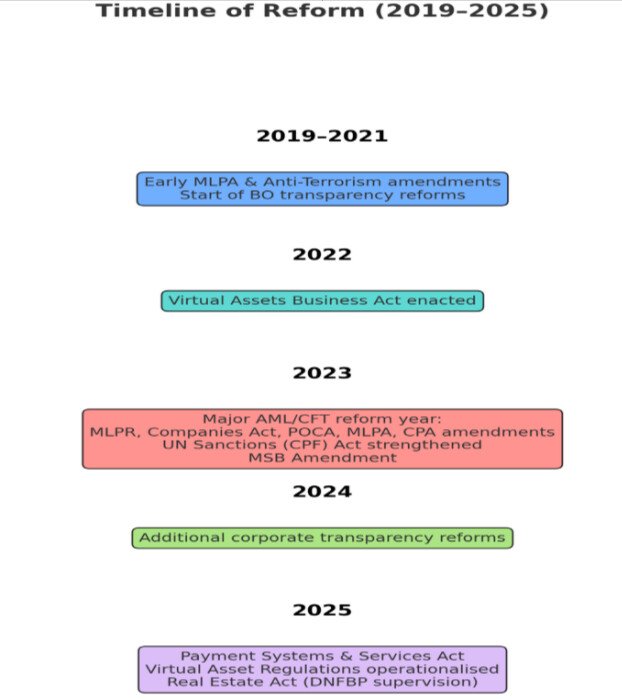
TIMELINE OF REFORM
2019–2021
- Early MLPA & Anti-Terrorism amendments
- Start of BO transparency reforms
2022
- Virtual Assets Business Act enacted
2023
- Major AML/CFT reform year: MLPR, Companies Act, POCA, MLPA, CPA amendments
- UN Sanctions (CPF) Act strengthened
- MSB Amendment
2024
- Additional corporate transparency reforms
2025
- Payment Systems & Services Act
- Virtual Asset Regulations operationalised
- Real Estate Act (DNFBP supervision)
Current Legislative Work (2025 and Beyond)
Upcoming Reform Areas
- Strengthening Targeted Financial Sanctions procedures
- Enhancing beneficial ownership verification and sanctions
- Expanding DNFBP supervision and fit-and-proper rules
- Harmonising supervisory sanctioning powers
- Drafting the Depreciating Assets Sale Order Bill to preserve asset value during investigations