About Attorney General’s Chambers
The Office of Attorney General is a constitutional office created under section 72 (1) of the Constitution of Saint Lucia, Cap. 1.01 (the Constitution). The Office can be, by virtue of section 72(2) of the Constitution, either a public office or the office of a minister. Section 61(2) of the Constitution goes on further to say that at any time when the office of the Attorney General is a public office, the Attorney General shall, by virtue of holding or acting in that office, be a member of the Cabinet in addition to the ministers, and shall be, in addition, a member of the House under section 30(3) of the Constitution.
Therefore, the primary role of the Attorney General is to act as the Government’s principal legal adviser and to promote the rule of law whenever he/she discharges his/her constitutional functions. The Attorney-General is thus obliged to give independent advice to the Cabinet, its ministers and to all government departments on all matters of law or on matters with legal consequences. This is to ensure that the Crown discharges the business of government in a lawful manner in observance of the rule of law.
Section 13 of the Crown Proceedings Act, Cap. 2.05 a statutory adjunct to section 72 of the Constitution, makes the Attorney General the nominal claimant or defendant in the majority of civil matters. It is this role and nominal status in civil proceedings which places on the Attorney-General, the duty to appear (through his/her law officers) on the government’s behalf in all matters litigated before the courts. The Attorney-General is therefore at liberty to appear personally before the courts, often in matters of considerable importance.
Moreover, what places the Attorney-General at the heart of the Constitution is his/her role as the guardian of the public interest. This is because the law reserves to the Attorney-General, the right to intervene in “the functioning of the justice system in the interests of supporting the system itself and maintaining public confidence in the administration of justice”.
This power, when exercised, is not amenable to judicial review. For instance, when he/she exercises that power: to bring relator actions, that is a power to represent the public in all legal proceedings for the assertion or protection of public rights..; to review an inquest under the Coroners Act, Cap. 2.16; to bring contempt proceedings (in relation to the media); to bring actions to restrain vexatious litigants; or to assert the privileges of parliament in the courts and to submit references to the courts on matters of constitutional importance.
¹ This does not mean that the Attorney General advices the public or any private citizen.
The Attorney General has additional responsibilities to Parliament; mainly on matters concerning the Constitution and the conduct of proceedings in Parliament. This includes legal questions concerning: parliamentary privilege; the conduct and discipline of members; and the meaning and effect of proposed legislation. On the latter, the Attorney General would liaise with the Director of Legislative Drafting on the propriety or legality of proposed legislation. The Attorney General may even intervene in court proceedings to assert the privileges of either Houses of Parliament, either of his or her own motion or, more usually, at the instance of the House authorities or indeed the trial judge. Such cases have usually arisen where parties seek to question proceedings in Parliament contrary to the Constitution. In that way, the Attorney General performs the important function of representing the interests of Parliament in the courts.
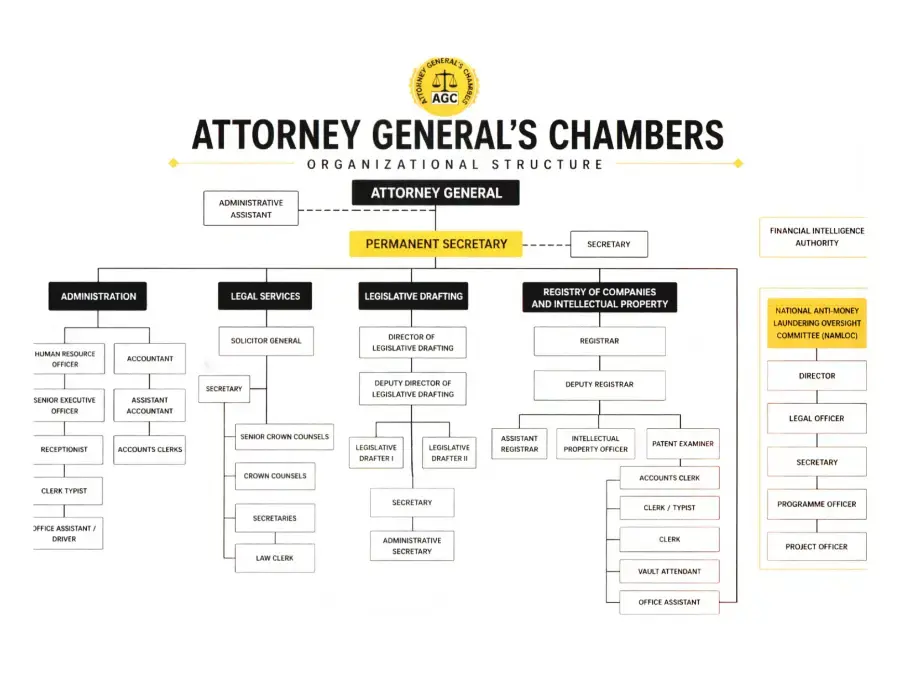
In the discharge of these duties, the Attorney General is assisted by his law officers (legally qualified attorneys appointed by the Judicial and Legal Services Commission), chief among whom, is the Solicitor General, who functions as the Attorney General’s delegate.’
The Attorney General also superintends:
- the Legislative Drafting Unit
- the Financial Intelligence Authority
- the Registry of Companies and Intellectual Property
- the National Anti-Money Laundering Action Committee (NAMLOC).
The current office holder is Mr. Leslie Mondesir, LLB (Hons), LEC